




Understanding XLH
This section is all about understanding X-linked hypophosphatemia (XLH) – what it is, what causes it, how it affects the body, and how symptoms can change over time.
Overview
X-linked hypophosphatemia, or XLH:
- Is a rare, genetic, life-long condition1
- Can impact the bones, teeth, joints, and muscles, and may cause back issues in both children and adults; changes in head shape are mainly seen in teens and adults1
- Is progressive, meaning symptoms can change or worsen over time2
- Affects up to 1 in 20,000 people, which means almost 17,000 people may have XLH in the U.S. alone2,3
Sarah
Living with XLH
Let’s take a closer look at what XLH means1:
A variation on the X chromosome
Low
Phosphate
In the blood
Keep reading to learn more about how a change in a gene (called a mutation or variant) leads to XLH.
One condition: Many names
You may hear your doctor or care team use different names for XLH. These may include:
- Familial hypophosphatemia4
- Familial hypophosphatemic rickets5
- Genetic rickets4
- Hereditary hypophosphatemic rickets6
- Hypophosphatemic rickets4
- X-linked hypophosphatemic rickets (XLH)4
- X-linked rickets (XLR)5
Historical terms for XLH that are not generally used today, but you still may hear include:
- Hypophosphatemic vitamin D-resistant rickets (HDPR)5
- Vitamin D-resistant rickets (VDRR)5
- X-linked vitamin D-resistant rickets4
For more information about the role of vitamin D in XLH and potential misdiagnoses of XLH, see the Starting the XLH Journey section on Diagnosing and Managing XLH.
Causes
XLH is a genetic condition.7 This means that a change in a gene causes XLH.7
- XLH is most often inherited, meaning it is passed from a parent to a child.1
- XLH can also be caused by a spontaneous (random) new genetic change.1 In these cases, a person develops XLH even though their parents don’t have the gene with a change that causes XLH.1 Regardless of whether XLH is inherited or spontaneous, the individual with XLH can pass on the genetic change to their children.1
- Changes in the phosphate regulating endopeptidase X-linked, or PHEX, gene cause XLH.8
Navigate to How XLH Affects the Body for more information about the PHEX gene.
X-linked means that the affected gene is found on the X chromosome.9
- Everyone’s chromosomes come in pairs, and everyone has at least one X chromosome.9
- The X chromosome is one of two, X and Y (the sex chromosomes), that determines if a child is male or female.9
- Children inherit one sex chromosome from each of their parents.
- Children born as female have two X chromosomes (XX).9
- Children born as male have an X chromosome and a Y chromosome (XY).9
- The PHEX gene is on the X chromosome but not on the Y chromosome.7 This is why XLH is an X-linked condition.
Did you know?
Although XLH is a hereditary condition, it can also occur spontaneously in those without any family history.1 About 20% to 30% of people with XLH developed it as a result of spontaneous genetic change, which can then be passed on to their future children.2
Let’s take a closer look at how XLH is passed down in families.
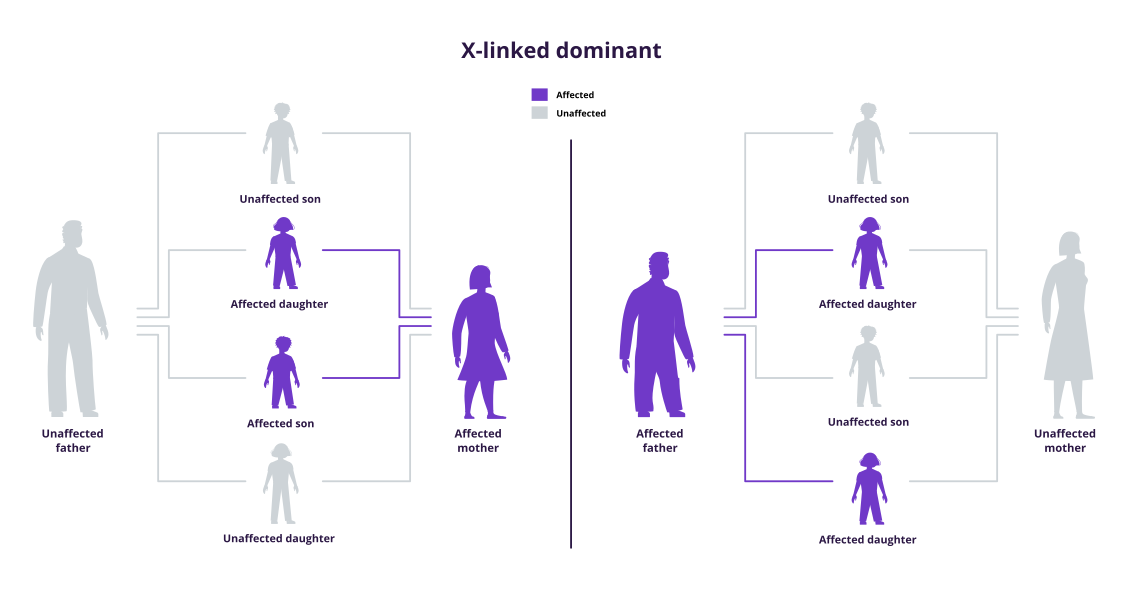
XLH is passed down in a dominant pattern.10 This means that only one X chromosome with the genetic change is needed for a person to have XLH.10
If the mother has XLH and the father does not, each of their children (both sons and daughters) will have a 50% chance of having XLH.10 That is because the children have a 50% chance of getting an X-chromosome with the genetic change from the mother.10
If the father has XLH and the mother does not, all daughters will have XLH because he is passing them an X chromosome with the genetic change in the PHEX gene.10 His sons will not get XLH because the father will pass on to his sons a Y chromosome.10 Y chromosomes do not carry the PHEX gene, which is only present on the X chromosome.7
Inheritance of an X-linked Dominant Condition like XLH
If XLH runs in your family, creating a family tree (called a pedigree) can help you learn:
- How XLH was passed across generations
- Who could pass XLH on to their children
- If any family members may have undiagnosed XLH
Navigate to the Genetic Counselors section on Diagnosing and Managing XLH for more information about genetic counselors.
How XLH Affects the Body
The PHEX gene helps control the amount of a hormone called fibroblast growth factor 23 (FGF23).12 FGF23 is made in the bone and circulates in the blood and helps keep the right amount of phosphate (also called phosphorus) in the blood.12 A change in PHEX can cause the body to make too much FGF23.12
Having too much FGF23 affects the kidneys in two ways:
- Prevents the kidneys from bringing phosphate back into the blood (called reabsorbing).7 Instead, the body loses phosphate through urine (called phosphate wasting).7 This can make the amount of phosphate in the blood too low.7
- Lowers the production of active vitamin D in the body, which decreases the amount of phosphate a person absorbs from their diet.13
Both phosphate and active vitamin D play important roles in the body.
Because the body uses phosphate to build bones, not having enough phosphate can cause problems in the bones and teeth.1 Unlike the parent and storage forms of vitamin D, XLH can cause active vitamin D levels to be low.1 As a result, prescription medication to increase active vitamin D may recommended by healthcare providers.1
Phosphate helps1,14:
- Build and repair bones
- Develop healthy teeth
- Supply muscle cells with energy
Active Vitamin D* helps14:
- Promote absorption of calcium and phosphate from foods that we eat
- Maintain calcium and phosphate concentrations in the blood
*There are three major forms of vitamin D.14
| Vitamin D (parent form) | Storage Vitamin D | Active Vitamin D | |
|---|---|---|---|
| Lab Name | Vitamin D3, Vitamin D2 | Calcidiol, 25(OH)D | Calcitriol, 1,25(OH)2D |
| Derived From | Food, supplements, or produced in the skin from sunlight | Made in the liver from vitamin D | Made by the kidneys from storage vitamin D |
| Directly usable by the body | No | No | Yes |
| Available over the counter | Yes, vitamin D supplement | No | No |
To learn more about monitoring XLH, see Monitoring XLH Throughout the Journey.
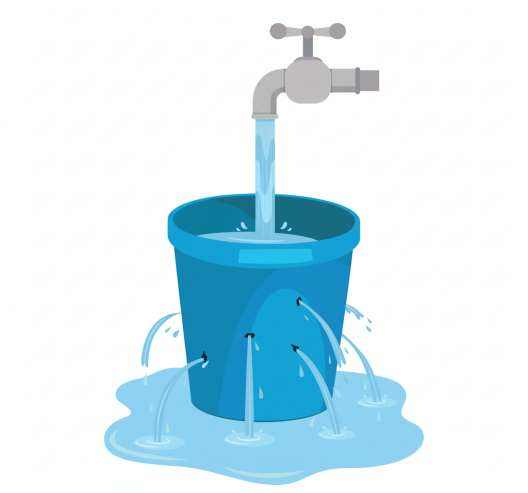
It might be helpful to picture a leaky bucket to understand how XLH affects the body.1,15
The water is like phosphate. The body takes in phosphate from food and drink.
Think of the bucket as a person’s kidneys that are trying to keep the level of water (the phosphate) filled to a certain level.
The holes in the bucket are caused by the PHEX variant which results in too much FGF23, so the phosphate is lost in the urine, like water leaking from the bucket.
A variation on the X chromosome
Low
Phosphate
In the blood
Symptoms and Signs of XLH
For people with XLH, low phosphate in the blood can contribute to bone problems, such as soft bones, but it does not explain all symptoms experienced.1 Symptoms can vary from person to person, and they may change over time—some people may experience mild symptoms, while others may have more serious symptoms at different points in their lives.1
Below are some common symptoms and signs of XLH. There may be other symptoms or signs of XLH that are not listed. Ask your doctor if you have questions about symptoms in general or if any symptoms change or worsen.
Developmental and Other Impacts
Bone, Muscle, and Tendon Issues
Dental Issues
Kidney Issues
Spinal Issues
Hearing Issues
XLH Symptoms Over Time
Symptoms can change over time and may be different in children and adults.18 For example, among individuals with XLH, children often have rickets, while adults often have osteoarthritis, spinal stenosis, and a higher likelihood of fractures.16,18
Since XLH is a progressive, life-long condition, timely management can help improve outcomes for things like bone and dental health.27,28
Symptoms of XLH, by Age Group16-20,25,26
For more information about managing XLH, see Diagnosing and Managing XLH.
To learn more about monitoring XLH, see Monitoring XLH Throughout the Journey.
References
- X-linked hypophosphatemia (XLH). Endocrine Society. https://www.endocrine.org/patient-engagement/endocrine-library/x-linked-hypophosphatemia. January 24, 2022.
- Dahir, K., et al. X-linked hypophosphatemia: a new era in management. J. Endocr. Soc. October 14, 2020. doi: 10.1210/jendso/bvaa151.
- U.S. and world population clock. U.S. Census Bureau. January 29, 2026. www.census.gov/popclock.
- Fuente, R., et al. Cellular and molecular alterations underlying abnormal bone growth in X-linked hypophosphatemia. Int J Mol Sci. January 15, 2022. doi: 10.3390/ijms23020934.
- Laurent MR, et al. X-linked hypophosphatemia. December 14, 2023. GeneReviews® [Internet].
- Hereditary hypophosphatemic rickets. MedlinePlus. https://medlineplus.gov/genetics/condition/hereditary-hypophosphatemic-rickets/. September 1, 2010.
- Carpenter, C., at al. A clinician’s guide to X-linked hypophosphatemia. J Bone Miner Res. May 2, 2011. doi: 10.1002/jbmr.340.
- NIH National Library of Medicine. PHEX phosphate regulating endopeptidase X-linked. January 6, 2026. www.ncbi.nlm.nih.gov/gene/5251.
- Gersten T. X-linked recessive genetic defects. MedlinePlus. medlineplus.gov/ency/imagepages/19097.htm. March 31, 2024.
- XLH (X-linked hypophosphatemia). Cleveland Clinic. https://my.clevelandclinic.org/health/diseases/x-linked-hypophosphatemia-xlh. May 31, 2024.
- Genetic counselor. Mayo Clinic. https://college.mayo.edu/academics/explore-health-care-careers/careers-a-z/genetic-counselor/. N.d.
- Guo, Y., Yuan,Q. Fibroblast growth factor 23 and bone mineralisation. Int J Oral Sci. February 2015. doi: 10.1038/ijos.2015.1.
- Aljuraibah, F., et al. An Expert Perspective on Phosphate Dysregulation With a Focus on Chronic Hypophosphatemia. J Bone Miner Res. January 2022. doi: 10.1002/jbmr.4486.
- Ross A, Et al. Dietary Reference Intakes for Calcium and Vitamin D. Institute of Medicine (US) Committee to Review Dietary Reference Intakes for Vitamin D and Calcium; 2011. https://www.ncbi.nlm.nih.gov/books/NBK56061/
- Phosphorus fact sheet for health professionals. National Institutes of Health, Office of Dietary Supplements. https://ods.od.nih.gov/factsheets/Phosphorus-HealthProfessional/. May 4, 2023.
- X-linked dominant hypophosphatemic rickets. National Institutes of Health, Genetic and Rare Diseases Information Center (GARD). https://rarediseases.info.nih.gov/diseases/12943/x-linked-dominant-hypophosphatemic-rickets. September 2025.
- Seefried, L., et al. XLH Matters 2022: Insights and recommendations to improve outcomes for people living with X-linked hypophosphataemia (XLH). Orphanet J Rare Dis. October 27, 2023. doi: 10.1186/s13023-023-02883-3.
- Skrinar, A., et al. The lifelong impact of X-linked hypophosphatemia: results from a burden of disease survey. J Endocr Soc. May 7, 2019. doi: 10.1210/js.2018-00365.
- Dahir KM, Li Z, Heerssen HM, et al. Real-world characteristics & disease history of patients with X-linked hypophosphatemia before treatment with burosumab. Arch Osteoporos. 2025;20(1):64. Published 2025 May 13. doi:10.1007/s11657-025-01544-1
- Nakamura, Yoshie, et al. Hypertension is a characteristic complication of X-linked hypophosphatemia. Endocrine Journal. 2017, 64 (3), 283-289. www.jstage.jst.go.jp/article/endocrj/64/3/64_EJ16-0199/_pdf.
- Dahash, B., Sankararaman, S., Rickets. StatPearls. January 2024.
- Zimmerman, L., et al. Osteomalacia. StatPearls. January 2024.
- Osteoarthritis. Mayo Clinic. https://www.mayoclinic.org/diseases-conditions/osteoarthritis/symptoms-causes/syc-20351925. April 8, 2025.
- Rabbani, A., et al. Dental problems in hypophosphatemic rickets, a cross sectional study. Iran J Pediatr. 2012. PMID: 23430969.
- Baroncelli, G., et al. Experts’ consensus on the management and treatment of individuals with X-linked hypophosphatemia across lifespan. J Endocrinol Invest 48, 2199–2228 (2025). doi.org/10.1007/s40618-025-02611-7..
- Spinal stenosis. Mayo Clinic. https://www.mayoclinic.org/diseases-conditions/spinal-stenosis/symptoms-causes/syc-20352961. June 27, 2024.
- Hamilton, A., et al. Whole body, whole life, whole family: patients’ perspectives on X-linked hypophosphatemia. J Endocr Soc. June 13, 2022. doi: 10.1210/jendso/bvac086.
- Rothenbuhler, A., et al. Diagnosis, treatment-monitoring and follow-up of children and adolescents with X-linked hypophosphatemia (XLH). Metab. Clin. Exp. 2020. doi: 10.1016/j.metabol.2019.03.009.